
Finding University of Leicester & UK Theses

Finding University of Leicester Theses

Browse the theses in your Department

If you want to look at previous theses within your Department or subject then choose the 'Research Archive' search on the library homepage and search on 'your department theses' e.g. geography theses:


This will open the Leicester Research Archive - scroll down and you will see the Theses Collection for the Department:


You can then browse the theses:


If you would like to read or download a particular thesis - click on the link and scroll down to the PDF option:


You will then be able to read or download the thesis unless it has an embargo in place, in which case the record will state there is an embargo:


Search by keyword or author

Go to the Leicester Research Archive homepage: https://lra.le.ac.uk/

Use the search box in the top right hand corner.

Finding UK Theses

Try searching:
EThOS - Electronic Theses Online System which is available via the British Library and searches over 400,000 theses. Search by keyword or author:
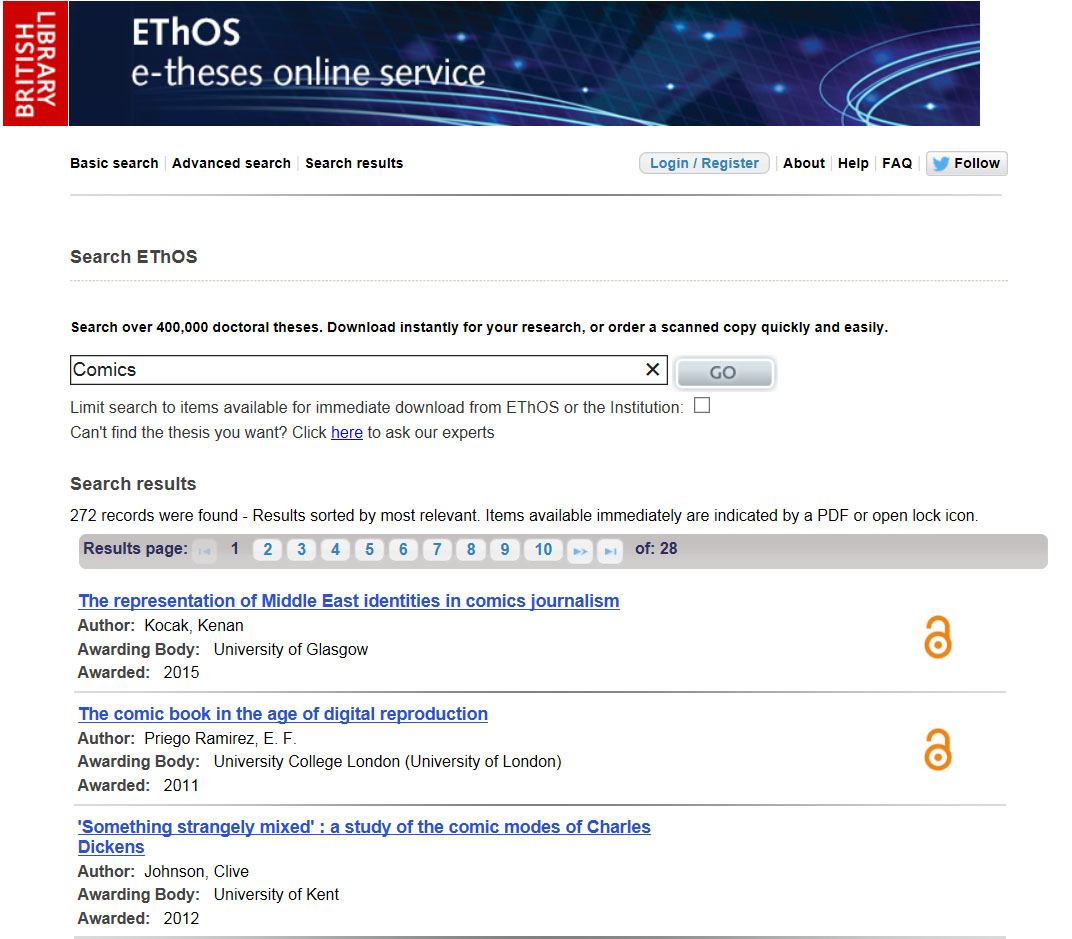

Some of the theses will be available as PDFs to download - look for the PDF symbol. You will be asked to create a free account in order to download the PDF.


If the PDF is not available and you would like to read the thesis then put in a Document Supply Request - if the request is successful it will cost you 5 or more of your Document Supply Quota (PGRs and Researchers have a free quota of 25 pr academic year).


If you would like to search for older theses or international theses then see our page on Theses and Masters' Dissertations

Popular posts from this blog

How to use SNL for financial research

Following the successful demonstration of Mergent Online , we have another database for you this week: SNL . SNL is a global financial database providing news, macroeconomic data and financials and analytics of banks and insurance companies. It replaces Bankscope, the database we previously used for this area. The data in SNL would be of interest for anyone researching finance, banking or insurance.   There will be two demonstrations of the new database SNL on  Wednesday 22 nd  February Session 1: 12.00 – 1.00 University Library IT Room 1 Session 2: 1.30 - 2.30.University Library IT Room 1 There is an opportunity to do some hands-on practice in these sessions as well receiving tailored support. If you would like to attend please contact  Andrew Dunn  with your details and any training requests. For more information on how to use and register for SNL follow this link:  http://www2.le.ac.uk/library/fi...

You can now export multiple citations from Google Scholar

You can now export multiple citations from Google Scholar if you have a Google Account. Go to Google Scholar and sign into your Google Account. Conduct your search. Click on the Star icon (Save) under each reference you want to export. Then click on My Library in the top, right of the screen. Select all the references and click on the Export option: Click the Star/Save Icon Choose Export Option To Export into EndNote Choose the EndNote option. Open the EndNote file that is created. The references should automatically import into EndNote. To Export into RefWorks Choose the RefMan option. Save the RIS file that is created. Login to your RefWorks account. Click on the plus (+) button. Choose Import References. Add the RIS file you just saved. Set the file import option to RIS - Reference Manager. Click import and your references will be imported. --- Good Practice Tip: Always check that all the reference information you need has been...

Search Tips: Phrase Searching and Proximity Searching

Phrase searching Normally when you put two words into a database search it will find those two words anywhere in the title/abstract/keywords: It will do an AND search = diabetes AND mellitus If you want to force the database to do a phrase search then enclose it in “speech marks” “diabetes mellitus” = those words next to each other, in that order Most of the main literature databases we subscribe to at the University of Leicester support phrase searching using speech marks, as do the search engines Google and Google Scholar. However, Scopus treats phrases in "speech marks" as loose phrases, so to do an exact phrase search in Scopus use {curly brackets} around the phrase instead. Extra Tip: Make sure when typing in speech marks that you use the double speech mark symbol " rather than typing in two apostrophes. Proximity (Adjacency) Searching Finds one keyword within a specified number of words of the other, in any order: Diabetes ADJ4 “Type 2” = will find Diabetes withi...